Sofwave in Seoul · Published
What the three FDA 510(k) summaries report
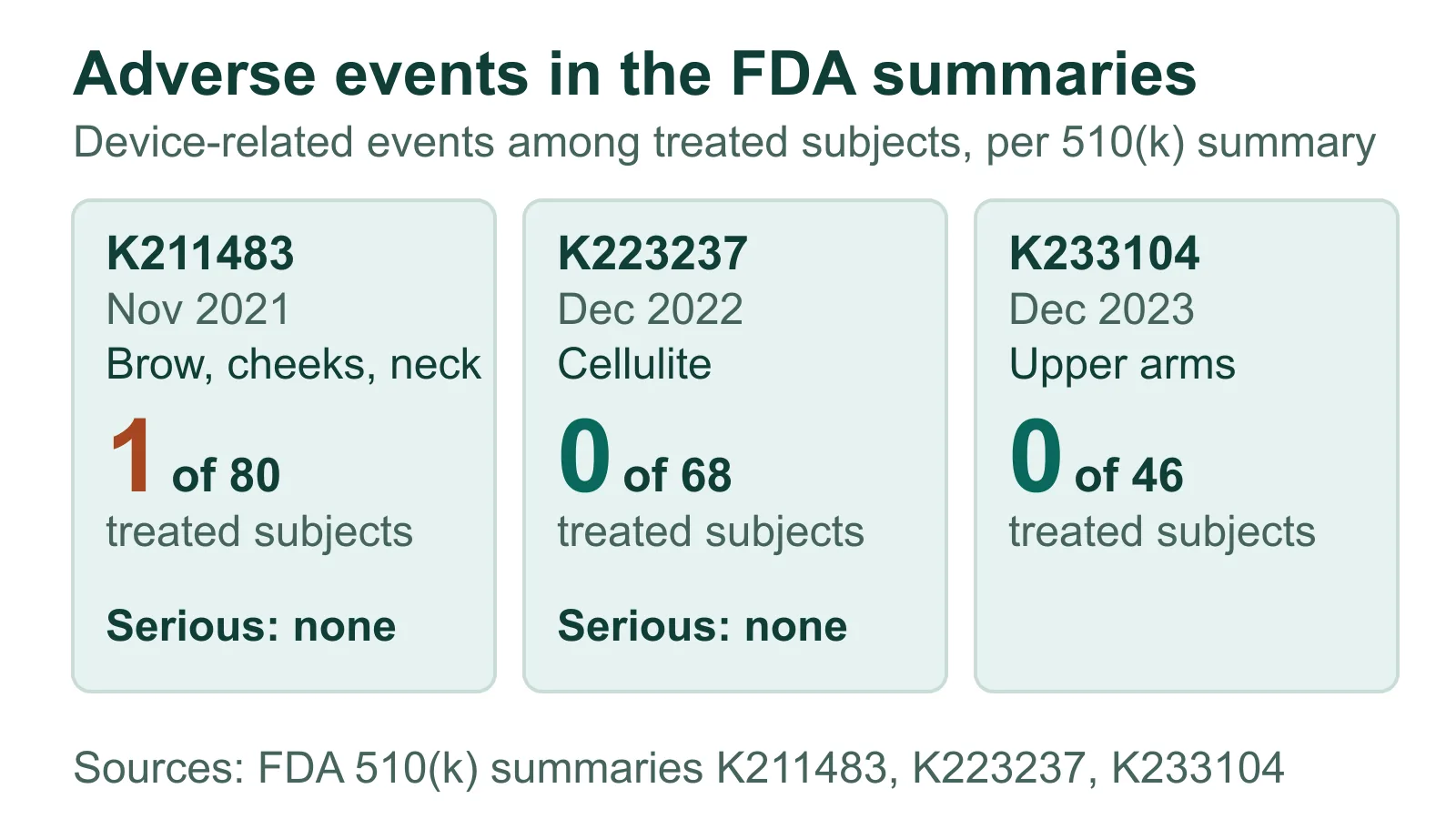
K211483, whose FDA letter is dated November 15, 2021, summarizes a study that enrolled 92 subjects and treated 80 at five US sites on the forehead and temples, the cheeks, and the area under the chin and the neck. It reports one device-related adverse event, "moderate, transient, and resolved completely with topical cream only", and no serious or unanticipated adverse event. [1]
K223237, with an FDA letter dated December 16, 2022, covers a cellulite study of 68 subjects treated at four sites on one side of the thighs or buttocks. One adverse event was reported, not related to the device, and no serious or unanticipated adverse event. [2]
K233104, with an FDA letter dated December 22, 2023, covers 46 subjects treated on both upper arms at four sites. It reports no device-related adverse events; the expected tissue responses were mostly redness (erythema) and swelling (edema) that resolved on their own. [3]
Redness and swelling in published studies
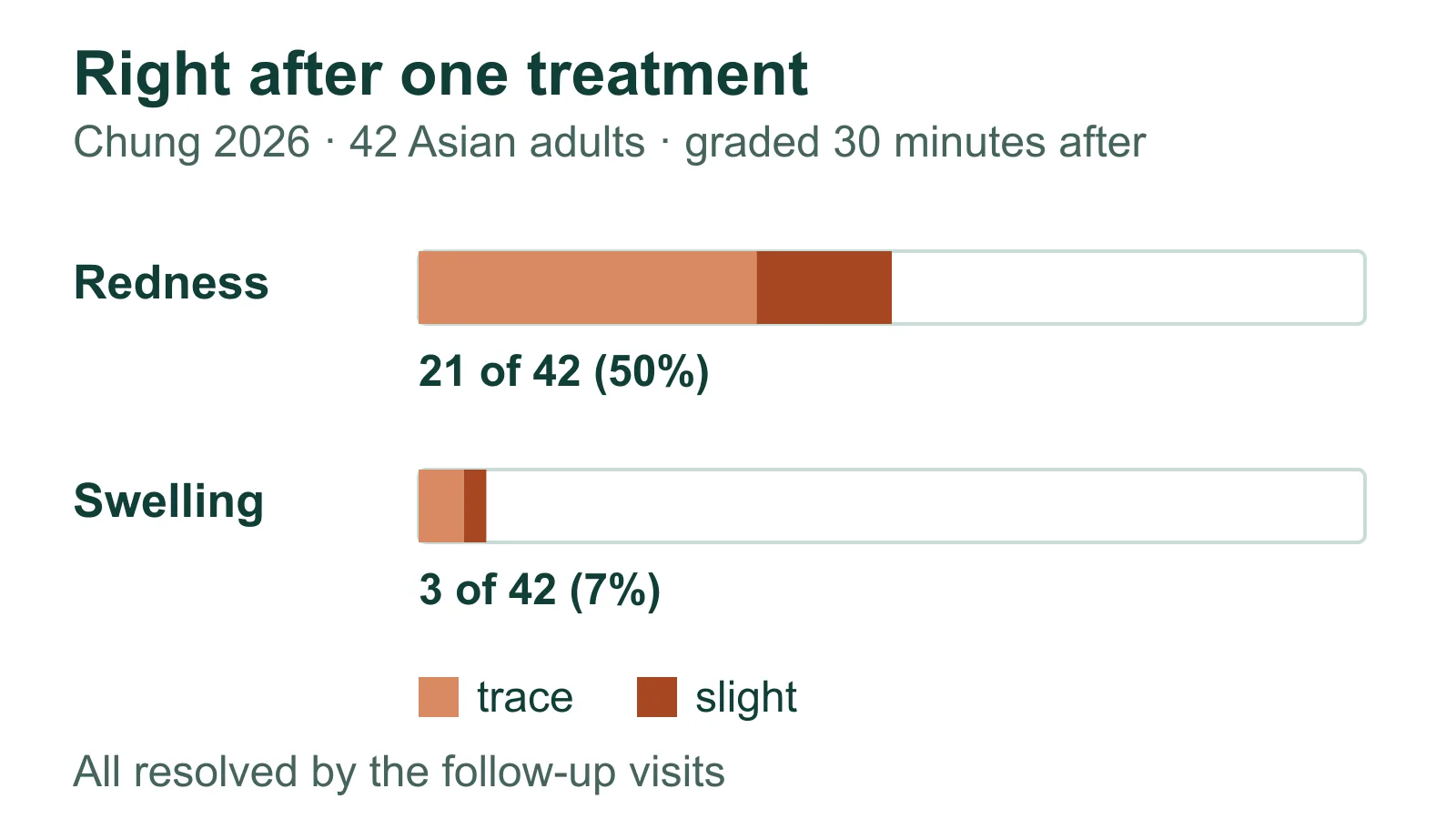
A 2026 study at the University of Hong Kong treated 42 Asian adults once over the full face and neck, including the area under the chin, after numbing cream. The investigators graded the skin 30 minutes after treatment, phoned each person at 24 hours and saw all 42 again at 3 and 6 months and 39 at 9 months. Right after treatment, 21 of 42 (50%) had trace or slight redness and 3 of 42 trace or slight swelling; all had resolved by the follow-up visits, and no bruising, blistering, burns, nerve injury or hyperpigmentation was reported at any follow-up visit. [4]
In a 2025 cellulite study of 60 women treated on the thighs or buttocks, 57 of whom completed both sessions, redness followed 56% of sessions and swelling 2%, and both resolved without intervention. Adverse events were recorded in four people; one was judged possibly related to the device, a mild tingling on the back of the thigh that lasted about two hours on the night after treatment. No serious adverse events were reported. [5] A 2025 case series of 14 Thai adults treated once for acne scars reported no adverse events. [6]
The short-term effects in a smaller two-session study of 15 women are described under aftercare and downtime.
What the device reports in MAUDE show
MAUDE is the FDA database of medical device reports of adverse events, from mandatory reporters such as manufacturers and from voluntary reporters. Searched by the brand name SofWave, it held 20 reports received from 2022 to October 13, 2026: 4 in 2022, 1 in 2024, 10 in 2025 and 5 in 2026. Eighteen were filed as injuries, one as a malfunction and one as other; 13 came from the manufacturer, 4 were voluntary reports and 3 came from distributors. [7]
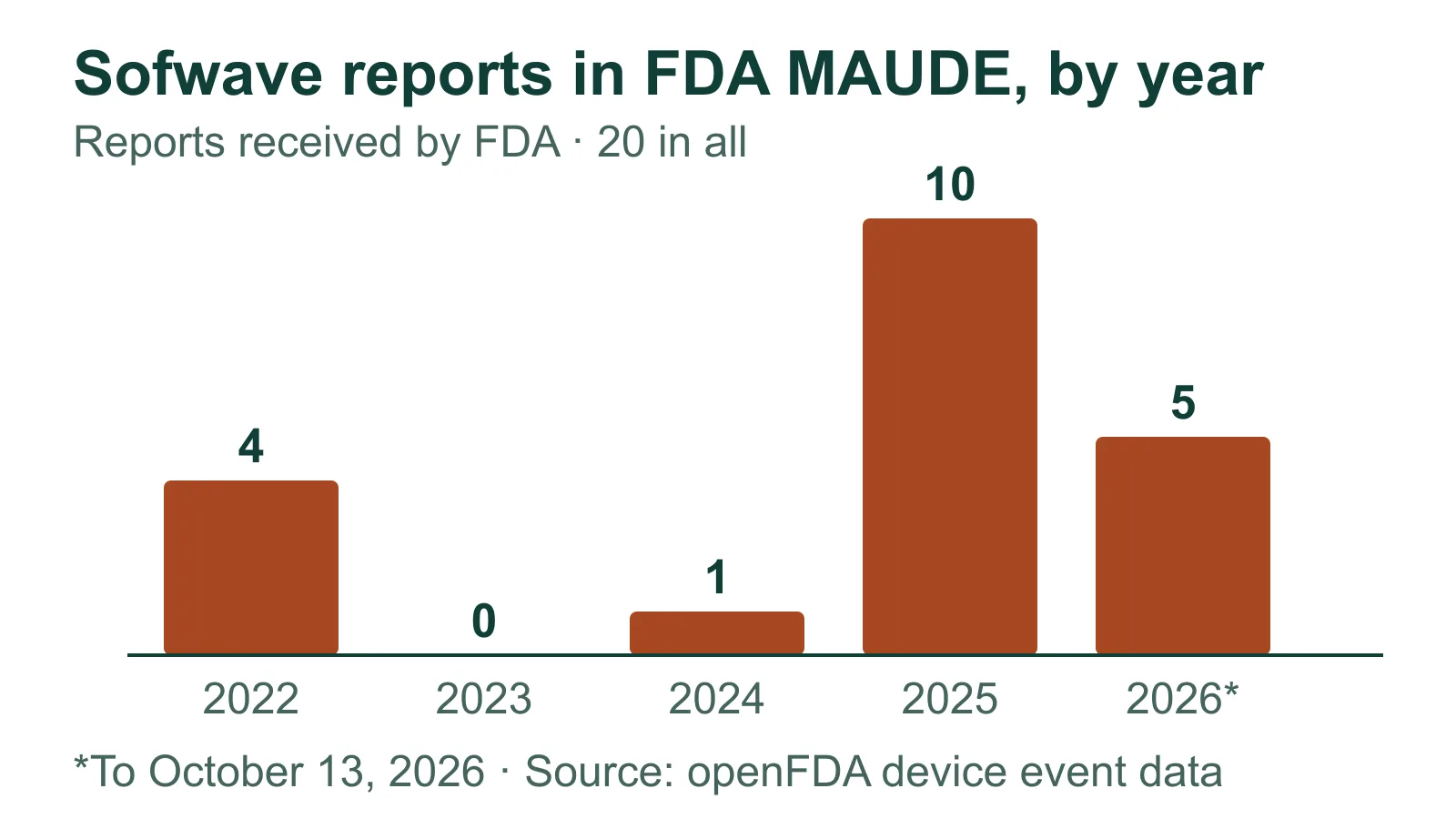
A report can carry several patient-problem codes. The most frequent were superficial (first degree) burn in 6 reports, insufficient information in 7, deformity or disfigurement in 3, and 2 each for hyperpigmentation, for hypopigmentation and for nerve damage. The FDA states that its device report data are not intended to be used to evaluate rates of adverse events or to compare them across devices. [7] [8]
Questions to ask before booking
- Which reactions should I expect on the day, and how long do they usually last after your treatments?
- Which zones will be treated, at what energy, and with how many passes?
- Whom do I contact, and how quickly, if blistering, numbness or a change in skin color appears?
Screening factors are covered in candidates and contraindications, and the Sofwave treatment notes from Delight Dermatology Clinic describe how one Seoul clinic plans a session.
Common questions
What are the side effects of Sofwave?
The reactions recorded most often are redness and swelling right after treatment that settle without treatment. In a 2026 study of 42 Asian adults treated once, 21 had trace or slight redness and 3 trace or slight swelling 30 minutes after treatment, and all had resolved by the follow-up visits. The three FDA 510(k) summaries with Sofwave trials report one device-related adverse event among 194 treated subjects, and two of them state that no serious adverse event was reported.
How long does redness last after Sofwave?
The trials describe redness that resolves on its own. In a 2025 cellulite study, redness followed 56% of sessions, resolved without intervention and was absent at every later visit; in a 2026 study of 42 adults, all redness seen 30 minutes after treatment had cleared by the follow-up visits.
Can Sofwave cause burns?
Six of the 20 Sofwave reports in the FDA MAUDE database by October 13, 2026 carry the patient-problem code superficial (first degree) burn. The 2026 study of 42 adults reported no burns, blistering, nerve injury or hyperpigmentation at any follow-up visit.
Sources
- US FDA. K211483, SofWave System: letter dated November 15, 2021 and 510(k) summary, clinical study on pages 5–6. Accessed November 1, 2026.
- US FDA. K223237, SofWave System: letter dated December 16, 2022 and 510(k) summary, clinical study on pages 4–5. Accessed November 1, 2026.
- US FDA. K233104, SofWave System: letter dated December 22, 2023 and 510(k) summary, clinical study on pages 3–4. Accessed November 1, 2026.
- Chung MMH, Wong CSM, Chan MWM, Shek SYN, Yeung CK, Chan HHL. Evaluating the use of high-intensity non-focused ultrasound treatment to improve skin laxity and facial wrinkles in Asian patients. Lasers in Surgery and Medicine, 2026;58(8):637-643. PMID 42226470. Study funding: Sofwave Medical Ltd.
- Gold MH, Bernstein EF, Chapas AM, et al. The efficacy and safety of synchronous parallel ultrasound for the clinical improvement of cellulite using high-density handpiece. Journal of Cosmetic Dermatology, 2025;24(12):e70597. PMID 41397931. Study equipment was provided by Sofwave, and two authors were Sofwave employees.
- Boonchoo K, Hongcharu W. The efficacy and safety of a single treatment of high-intensity, high-frequency, non-focused ultrasound parallel beams for facial acne scars in Asian patients: a preliminary study. Journal of Cosmetic Dermatology, 2025;24(4):e70134. PMID 40132902.
- US FDA. MAUDE, Manufacturer and User Facility Device Experience database. Counts from the openFDA device adverse event data for the brand name SofWave, data updated October 13, 2026, retrieved November 1, 2026.
- US FDA. About the Manufacturer and User Facility Device Experience (MAUDE) database, content current as of December 8, 2025.