Is Sofwave a laser? Ultrasound and laser energy, explained
Delight Dermatology editorial team · Published
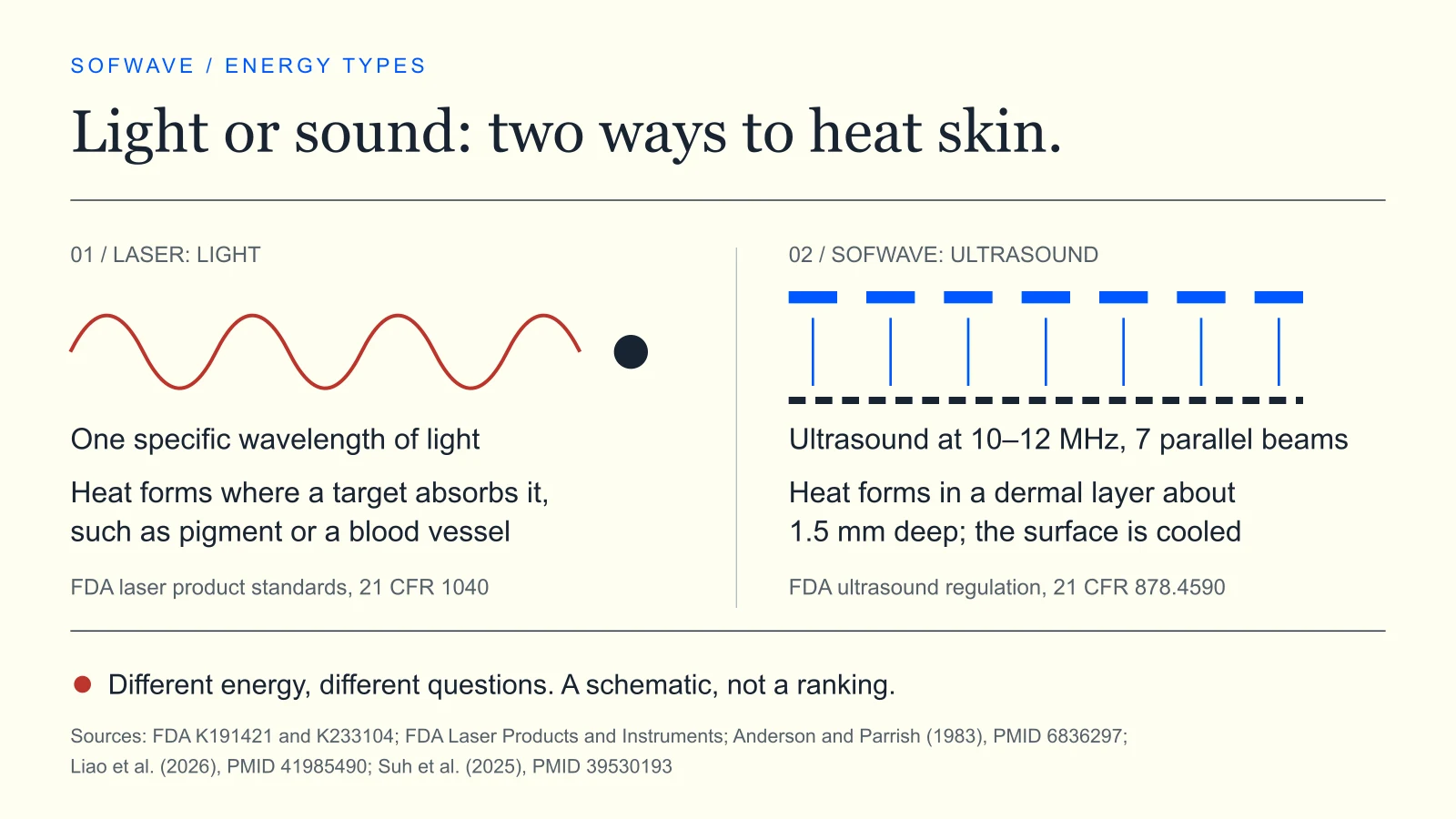
No. Sofwave is an ultrasound device, not a laser. FDA's 510(k) summaries describe the SofWave System as an ultrasound system whose transducers emit acoustic waves at 10–12 MHz and raise the temperature of the dermis while a cooling element cools the skin surface. [1] A laser heats with light of one specific wavelength, absorbed by a target such as pigment or a blood vessel. [2] [3] The two energies raise different questions about eye protection, skin type and what is being heated. These differences alone do not establish comparative effectiveness or safety.
What the FDA record says Sofwave is
Sofwave's first US clearance, K191421, was decided on September 9, 2019, when the device was called the Sofacia System. Its 510(k) summary describes “an ultrasound system intended for aesthetic purposes” that generates high-frequency ultrasonic pulses to raise the temperature in the dermis. The comparison table lists the energy type as high-intensity ultrasound, the frequency as 10–12 MHz and the treatment depth as 1–2 mm. The applicator pairs an array of ultrasonic transducers with a thermoelectric cooler that keeps the epidermis cool. [1]
The device is filed under 21 CFR 878.4590, product code OHV, the same regulation as the Ulthera System it was compared with in 2019. Neither summary cited here uses the word laser or the word light. One label can mislead: the category is named for focused ultrasound, yet the later K233104 summary describes Sofwave's technology as “high intensity non-focused ultrasound.” Read the category name as a regulatory grouping, not as a description of this device's beam. [1] [4]
How a laser heats skin
FDA explains that laser stands for light amplification by the stimulated emission of radiation, and that laser light has a specific wavelength where ordinary light mixes many. Laser manufacturers must comply with FDA's performance standards for laser products, 21 CFR 1040.10 and 1040.11. Lasers used in medicine must also comply with the medical device regulations. [2]
In skin, a laser's heat forms where its light is absorbed. The 1983 paper that described selective photothermolysis showed that brief pulses of selectively absorbed light could damage pigmented structures or small blood vessels, depending on the wavelength used. [3] So a laser plan starts from a target: which structure is meant to absorb the light, and what else in the skin might absorb it too.
How Sofwave heats skin instead
Ultrasound is sound, a pressure wave pitched far above human hearing. In the SofWave System, seven transducers sit in direct contact with the skin and send parallel beams to one fixed depth of about 1.5 mm, in the mid-dermis. [5] [6] Part of that acoustic energy turns into heat in the tissue. [1] One published Korean protocol applied a topical anesthetic cream and then an ultrasound gel before treatment. [6]
Two biopsy studies place the effect in the dermis. A report on 13 women treated once in Korea found collagen remodeling at 1–3 mm from the epidermis two months later. [6] A study that used a pig model for the acute heat injury, and human biopsies for ten months afterwards, reported that the thermal injury was restricted to the dermal layer. Its author group includes authors affiliated with Sofwave Medical. [7]
How it differs from other ultrasound devices
Ultrasound devices for skin do not all deliver energy the same way. Microfocused ultrasound converges energy to small points. A 2026 review describes microfocused ultrasound with visualization treating at depths from 1.5 to 4.5 mm, down to the superficial musculoaponeurotic system (SMAS), while SUPERB delivers energy at a fixed 1.5 mm. [5] The 2019 FDA comparison shows the same split in hardware: the predicate used a focused, dome-shaped transducer at 4–10 MHz, and Sofwave an array of piezoelectric plates at 10–12 MHz. [1]
These are differences in geometry and depth, not evidence that one device works better. For a comparison of treatment depths, see Sofwave vs Ultherapy. Device parameters are collected on what Sofwave is and how it works.
Three questions the energy type changes
Eye protection
FDA lists medical lasers for eye surgery or skin treatment among its Class IV examples, a class with an immediate eye and skin hazard from the direct or reflected beam. [2] For a laser treatment, ask what eye protection you and the staff will wear. The Sofwave 510(k) summaries describe ultrasound energy but do not set out eye-protection requirements. [1] [4] Ask the clinician which precautions the device instructions require for the planned area.
Skin type
With many lasers, skin color is a central safety question. A review of laser and light treatment for Fitzpatrick skin types V and VI describes a greater risk of pigment change and scarring in skin with more epidermal melanin, and calls for careful choice of device and settings. [8] Because the FDA summaries describe acoustic rather than optical energy, Sofwave's heating does not rely on light absorption by melanin. [1] That does not establish its risk of pigment change or scarring in darker skin, or its safety compared with lasers.
What the studies report is who was enrolled: Fitzpatrick types I–VI in the multicenter acne-scar study, I–IV in the upper-arm study, and, in the Korean biopsy report, twelve people of type III or IV and one of type V. [9] [10] [6] Enrollment is not a risk estimate for each type, and the two multicenter abstracts do not report outcomes by skin type.
- Which studies included people with my skin type, and how many?
- Which pigment or scarring risks apply to my skin, and how would they be managed?
What is being heated
For either treatment, ask which tissue is being targeted. Sofwave delivers ultrasound at a fixed depth of about 1.5 mm. [5] Ask how the skin surface is protected and why that depth matches your concern. If the concern is pigment, visible vessels or deeper tissue, ask which other treatments should be compared.
Delight Dermatology, which publishes this site, describes its own Sofwave protocol on the clinic's Sofwave page. Screening factors are covered in candidates and contraindications.
What this page does not claim
Calling Sofwave an ultrasound device describes its energy; it does not rank it. This page does not claim that Sofwave is more effective, more comfortable or safer than any laser or any other ultrasound device, or that it suits every skin type. A 510(k) clearance is a US regulatory decision for listed indications. It is not approval, and it does not establish Korean authorization or availability at a particular clinic. [4]
On the sources: the pig-and-biopsy study includes authors affiliated with Sofwave Medical [7], and the Korean biopsy report's authors declared no conflicts of interest [6]. The PubMed records of the two multicenter studies are not complete funding disclosures. Read the full papers and their disclosures before treating that evidence as independent. [9] [10]
Common questions
Is Sofwave a laser?
No. FDA 510(k) summaries describe the SofWave System as an ultrasound system whose transducers emit acoustic waves at 10–12 MHz to raise the temperature of the dermis. A laser uses light of a specific wavelength.
Does Sofwave need laser eye protection?
Sofwave is not a laser, but that does not settle which eye precautions apply. The SofWave 510(k) summaries describe ultrasound energy but do not set out eye-protection requirements. Ask the clinician which precautions the device instructions require for the planned area.
Is Sofwave safe for darker skin because it is not a laser?
Not on that reasoning. Because the FDA summaries describe acoustic rather than optical energy, Sofwave's heating does not rely on light absorption by melanin. That does not establish its risk of pigment change or scarring in darker skin, or its safety compared with lasers. Ask which studies included people with your skin type, and how many.
Is Sofwave the same as focused ultrasound?
Both heat tissue with ultrasound, but the geometry differs. Microfocused ultrasound converges energy to points at selectable depths, while Sofwave sends parallel, non-focused beams to one fixed depth of about 1.5 mm. That is a design difference, not evidence that one is better.
Why does the FDA category mention focused ultrasound?
The SofWave System is filed under 21 CFR 878.4590, a category named for focused ultrasound that it shares with focused devices. Its K233104 summary describes the technology itself as high intensity non-focused ultrasound.
Sources
- US FDA. K191421 510(k) summary, Sofacia System (now the SofWave System). Decision date September 9, 2019. Device description and comparison table.
- US FDA. Laser Products and Instruments. Content current as of November 13, 2024.
- Anderson RR, Parrish JA. Selective photothermolysis: precise microsurgery by selective absorption of pulsed radiation. Science, 1983. PMID 6836297.
- US FDA. K233104 510(k) summary, SofWave System. Decision date December 22, 2023. Classification name and technology row of the comparison table.
- Liao D, Prasad A, Bloom JD. Use of ultrasound in face and neck rejuvenation. Facial Plastic Surgery, 2026. PMID 41985490. Review.
- Suh DH, Lee SJ, Song KY, Ahn HJ, Shin MK. High-intensity, parallel ultrasound tightening of facial skin: clinical and pathologic results. Journal of Cosmetic Dermatology, 2025. PMID 39530193. The authors declared no conflicts of interest.
- Carruthers J, et al. Synchronous parallel ultrasound induces long-term extracellular matrix remodeling of human skin. Dermatologic Surgery, 2025. PMID 41405933. Includes authors affiliated with Sofwave Medical.
- Alexis AF. Lasers and light-based therapies in ethnic skin: treatment options and recommendations for Fitzpatrick skin types V and VI. British Journal of Dermatology, 2013. PMID 24098905. Review.
- Wang JV, et al. High-intensity, high-frequency, parallel ultrasound beams for facial acne scars. Dermatologic Surgery, 2025. PMID 40152353.
- Wang JV, et al. High-intensity, high-frequency, parallel ultrasound beam device for skin laxity of the upper arms. Dermatologic Surgery, 2025. PMID 40152327.